
Collaboration
Get the Family Mental Load Out of Your Head
List what you remember for the whole family, then move the recurring items into a shared plan and give each one an owner.
Published Oct 11, 2026 6 min read FamilyGoal team
Collaboration
List what you remember for the whole family, then move the recurring items into a shared plan and give each one an owner.
Keep reading
A short weekly family check-in for calendars, meals, responsibilities and the small details that can catch everyone off guard on Monday.
6 min readLess chasing, fewer forgotten details, and a clearer sense of what comes next for everyone in the family.
Available today on the web, App Store, and Google Play.
Download FamilyGoal for iPhone or Android.


You are halfway through making dinner when you remember the field-trip form. It needs a signature by tomorrow, and it may still be in a backpack by the door. Before the pasta is ready, you have also remembered that the car insurance renews next week and that Thursday's gym clothes are in the laundry pile. You never wrote any of it down, so the rest of the family can't see it.
That carrying has a name: the family mental load. It covers the noticing, remembering and checking that sit around the visible chores. You can share it with the people you live with, and the first step is to see how much of it there is. Start by listing what lives in your head. Then move the recurring items into a shared plan and give each one an owner.
Sociologist Allison Daminger interviewed 35 couples about how they ran their homes. She described a layer of household work that surrounds the visible jobs: anticipating needs, identifying options, making decisions and monitoring progress. She called it cognitive labor. It was a frequent source of conflict for the couples she spoke to, in part because so much of it went unseen (Daminger, 2019).
A birthday party shows the two layers. The visible part takes an afternoon: someone buys a gift and drives to the party. The invisible part starts a week earlier, when someone spots the invitation, checks the calendar, replies, asks the child what their friend likes and makes sure the gift gets wrapped. The second list tends to go missing when a couple compares who does more.
Researchers who study this work have found a pattern in the households they looked at. In Daminger's interviews, women did more of the anticipating and monitoring, while the couples tended to share decisions. In a survey of 393 mothers, 88 percent said they were mostly responsible for organizing the family's schedule (Ciciolla and Luthar, 2019). Both studies looked at particular groups of parents, and the survey's authors warn against generalizing from their sample of mostly White, upper-middle-class mothers in mixed-gender marriages. In your home the person carrying the most might be a mother, a father, a grandparent, or a single parent with no one to hand it to.
Asking for help is a good start, and it can still leave you as the manager. Say your partner agrees to take your son to the dentist. You booked the appointment, you remember the date, you send a reminder that morning and you ask afterward whether the dentist wants a follow-up visit. Your partner handled the drive, and the remembering stayed with you.
To share the load, give one person the whole job: noticing it is coming, planning it, doing it or arranging it, and checking it is done. Once someone owns the dentist, they also own the next booking.
For three or four days, keep a running note on your phone or a sheet of paper on the fridge. Each time you remember something on someone else's behalf, add it, including the small ones.
These prompts can help you catch the ones that slip past:
Include the checking as well as the doing. "Did the library book go back?" belongs on the list.
Sort your list by the kind of home each item needs, so the right person can find it without asking you.
| What you remember | Where it lives | Example |
|---|---|---|
| Anything with a date or time | The shared calendar | Dentist, Thursday at 4 p.m. |
| A one-off action | A task with one owner | Sign the field-trip form |
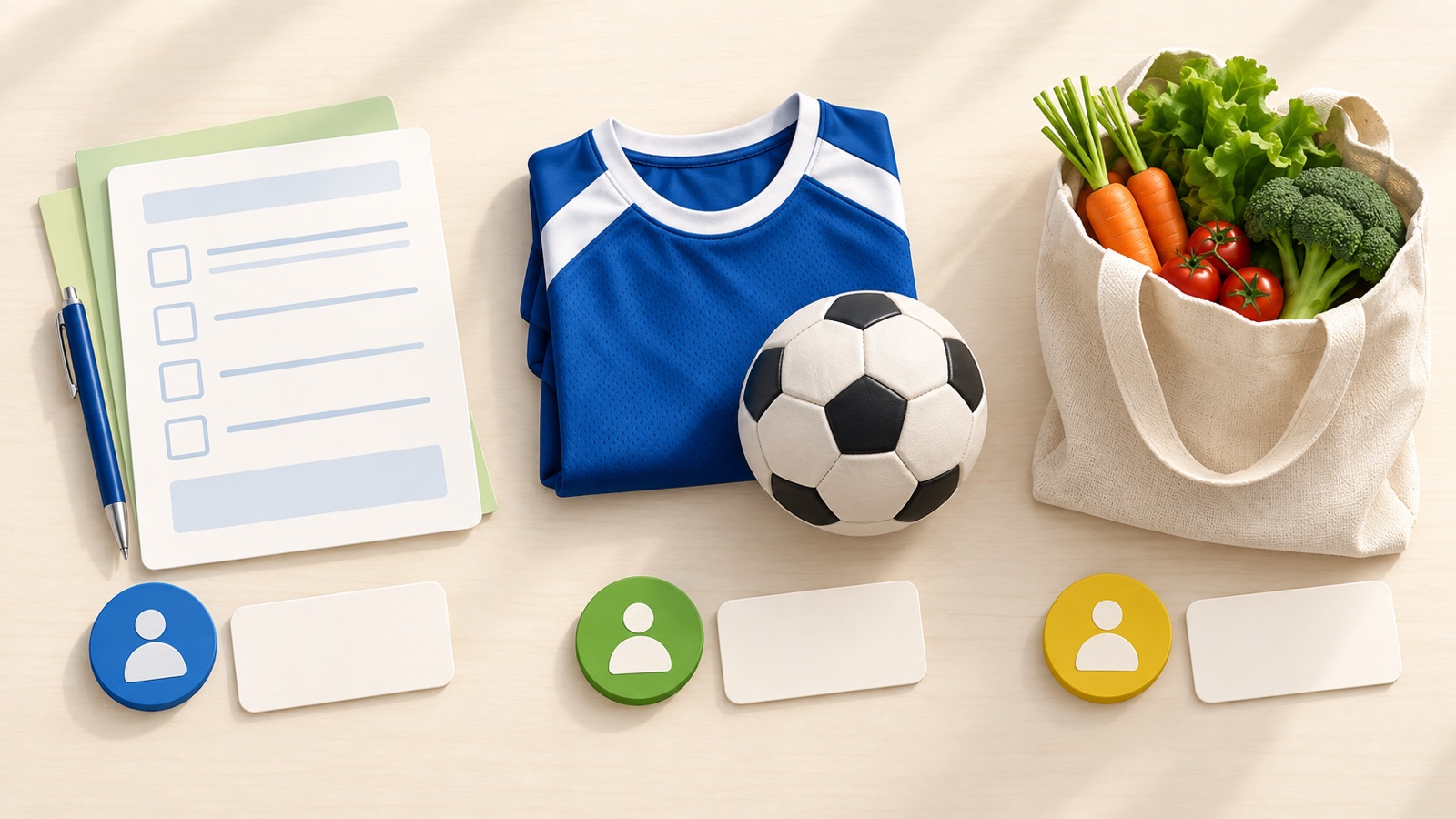
| Work that repeats | A routine with an owner | Pack the soccer bag on Tuesdays |
| Meals and groceries | The meal plan and shopping list | Tacos on Wednesday, buy tortillas |
| Money and paperwork | A planned expense or a task | Car insurance renews on the 14th |
| Things people look up | A shared note or contact | Shoe sizes, the school office number |
The recurring items matter most. You sign a field-trip form once, while the soccer bag and the weekly grocery run come back until someone else owns them.
Pick an owner for each recurring item and agree on what owning it means. For the soccer bag, ownership might mean checking the practice schedule on Sunday, washing the uniform on Monday and packing the bag on Tuesday morning. Let the owner decide how to do it. If you redo the job each time it looks different from your version, you end up carrying it again.
Children can own jobs too. A younger child might own putting their library book in their bag on Wednesday night. A teenager might own checking practice times and telling you about changes. Match the job to the child, and keep an adult responsible for anything the child is not ready to manage.
Owners need to see the plan without asking you. A job that lives in your notebook keeps you as the only person who knows about it.
A shared plan stays useful when the family checks it together. A short weekly look, such as the 15-minute Sunday Family Reset, gives each owner a moment to see what is coming and ask for what they need. Use the same few minutes to catch anything you have started carrying again, and give it a home.
Moving everything at once turns the fix into another project. Choose the three recurring things you remember most. Give each one a home and an owner, and leave the rest of the list for later. After a week, check whether anyone had to ask you about those three. If no one did, choose three more.
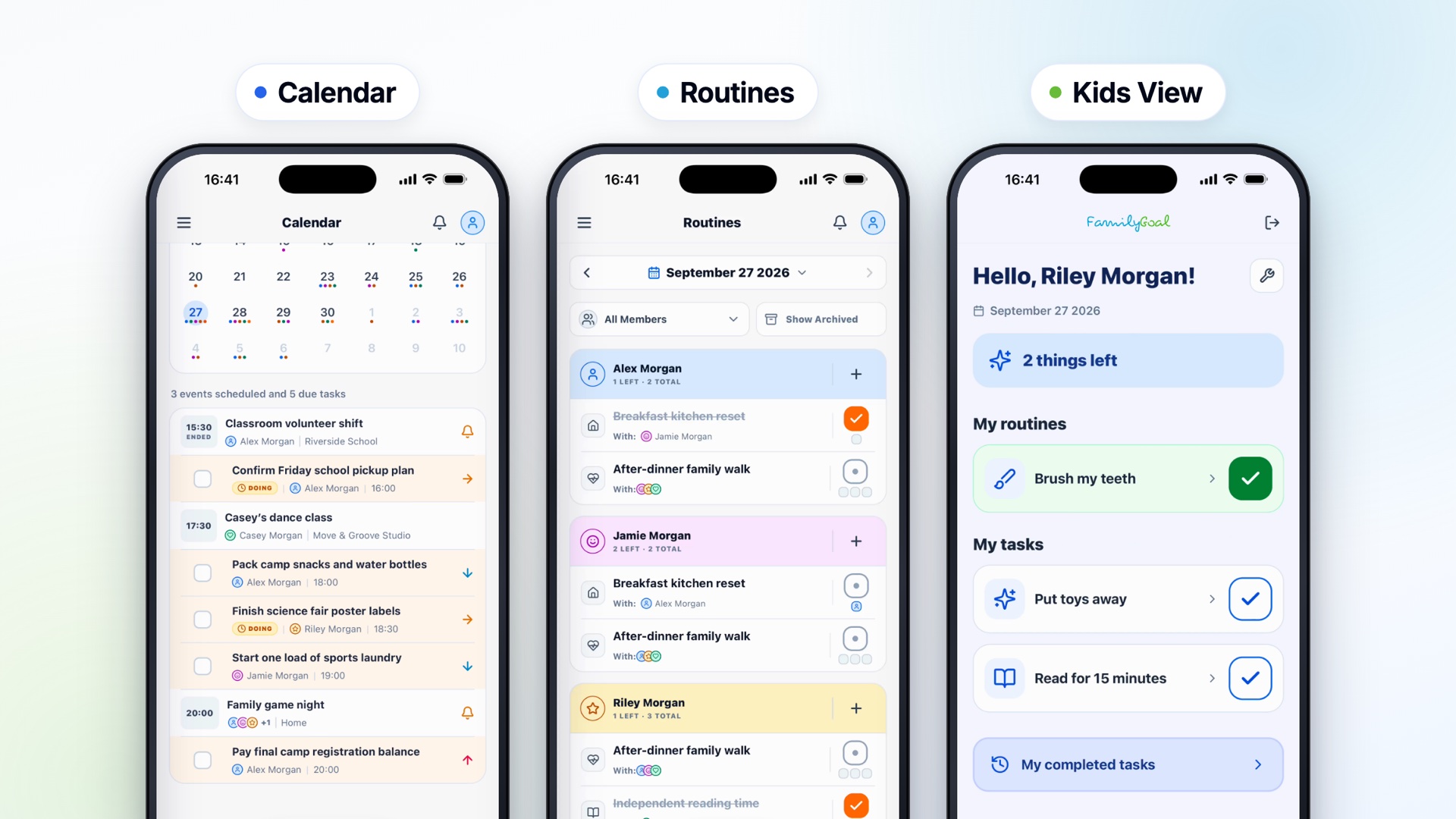
FamilyGoal's shared family organizer gives each kind of item its own place. An event can have participants and reminders. Tasks have an assignee and an optional due date, and routines can go to one or more people on a daily, weekly or custom schedule. Meals show who is cooking, a recipe's ingredients can go onto the shared shopping list, and planned expenses and recurring payments live in finances. Notes and contacts hold the details people look up.
Each member sees the parts of the plan their access allows, and you can filter the Home screen to one person's day. In the native mobile app, a child using Kids View sees the tasks and routines assigned to them for today.
This week, choose three recurring things you carry in your head and make them visible to your family. Give each one an owner who can find it without asking you.