
Planning
Why Shared Calendars Don't Work Unless the Whole Family Uses Them
Agree on what goes in your shared family calendar and who adds each plan, so the whole family keeps it current.
Published Oct 17, 2026 7 min read FamilyGoal team

Planning
Agree on what goes in your shared family calendar and who adds each plan, so the whole family keeps it current.
Keep reading
List what you remember for the whole family, then move the recurring items into a shared plan and give each one an owner.
6 min readA short weekly family check-in for calendars, meals, responsibilities and the small details that can catch everyone off guard on Monday.
6 min readLess chasing, fewer forgotten details, and a clearer sense of what comes next for everyone in the family.
Available today on the web, App Store, and Google Play.
Download FamilyGoal for iPhone or Android.


Your partner can open the family calendar on their phone, and so can your teenager. You still keep it up to date. You add the dentist appointment and move soccer practice when the coach texts, and anyone who needs the pickup time asks you. The others check the calendar the way they check the weather, trusting you to get it right.
Researchers have described this arrangement for years. In a study of 44 Canadian and American families, Carman Neustaedter, A. J. Bernheim Brush and Saul Greenberg found that almost every family had a primary scheduler: the person most responsible for putting activities on the calendar and making sure the others knew about them. In 41 of the 44 families, that person was the mother. In two-thirds of the families, the others took little or only occasional part in keeping the calendar, and they often learned about plans from the scheduler's reminders or by asking her (Neustaedter, Brush and Greenberg, 2009). The study is from 2009. A decade later, 88 percent of the 393 US mothers in another survey said organizing the family's schedule was "mostly me" (Ciciolla and Luthar, 2019). Both studies looked at particular groups, most of them mothers in mixed-gender couples, and your home may divide the work another way. Keeping the calendar is one visible part of the family mental load.
The researchers also met families who preferred a single scheduler, because the parents had split their responsibilities on purpose. You run into trouble when the arrangement happens by default: one person keeps the calendar because they noticed first, and the others stop checking. Sharing access leaves that job where it was. Your family needs a few agreements about what goes in the calendar and who puts it there. Call them house rules. Seven follow, and you can start with the first.
If you put every appointment and meeting on the family calendar, you lose the plans that matter among the rest. Keep it for plans that affect more than one person: a pickup, a late dinner, a school event that needs an adult, a work trip that moves bedtime. Your own meetings can stay in your work calendar until one of them changes the family's evening.
The calendars in the 2009 study had this in common: each event affected the family in some way, either by involving more than one person or by changing someone's routine, such as a parent's new work hours.
Different people in your family hear about plans first. The coach texts one parent and the school emails the other. Your teenager hears about the extra rehearsal at lunch. If each of them forwards the news to the calendar keeper, the keeper stays the only person who writes anything down.
Agree that the first person to hear about a plan adds it the same day, even with details missing. "Rehearsal Thursday, time to confirm" already tells the family to keep that evening open, and the person who added it can fill in the time later.
If an entry says "Swim," the rest of the family has to guess who is swimming and who is driving. Put the name of the person the plan is for in each entry, and for anything that needs an adult, add who is handling it. In the families Neustaedter's team studied, parents often settled who would go along or drive much closer to the day than when they wrote the event down. Leave the driver blank and expect a phone call at five asking who is going.
Colors help you read a busy week at a glance. Half of the 20 families whose calendars the researchers examined used colors, for a person or a type of activity, and several people had stopped because the right pen was hard to find or they no longer had the time.
Assume the person reading the entry missed the conversation, and give them enough to act on: the time and the place, plus anything they need to bring. "Swim meet, 8:00, Riverside pool, blue kit, Sam drives" takes a few more seconds to type than "Swim" and saves a round of texts.
The families in the 2009 study needed room for these details too. Half of the families whose calendars the researchers examined kept phone numbers and activity handouts in the margins or tucked into the calendar, because the details did not fit in a day's box.
Plans move. Update the calendar before you send the message about the change, so the calendar and the family group chat agree. Then tell the people the change affects: "Soccer moved to 6 on Saturday. Calendar updated."
You still need the message. On a paper calendar, anyone who looks can see a crossed-out event and know that something changed. The researchers noted that editing a digital calendar often leaves no visible trace of the change, so the people affected rely on someone telling them.
The primary schedulers in the 2009 study checked the family calendar daily, in the morning or the evening. In most of the families, the others checked it less often or relied on the scheduler to tell them. A short weekly look, such as the 15-minute Sunday Family Reset, puts the whole family in front of the same week. Use it to spot the fixed times and the plans that still need a name.
Children can take part in the calendar long before they keep one. A preschooler can look at today's plan with you over breakfast. One five-year-old in the 2009 study looked at the family calendar from her end of the dinner table and told her parents what they were doing on Saturday. A school-age child can tell you about an event they hear of first, so you can add it together. A teenager can add their own plans and check their own week.
Harvard's Center on the Developing Child notes that teenagers face growing expectations to be independent and organized in their schoolwork, and it suggests keeping a calendar of deadlines as one support (Center on the Developing Child, 2014). Pick the part that fits your child, and keep the adults responsible for rides and anything else your child isn't ready to manage.
You can start with the calendar you have. Set aside twenty minutes with the people who share it. Delete the cancelled plans and last season's repeating lessons, then add the fixed points for the next two weeks. Agree on the first rule, and decide who watches each place plans come from, such as the school emails and the team's messages. Leave the rest of the cleanup for your next weekly look.
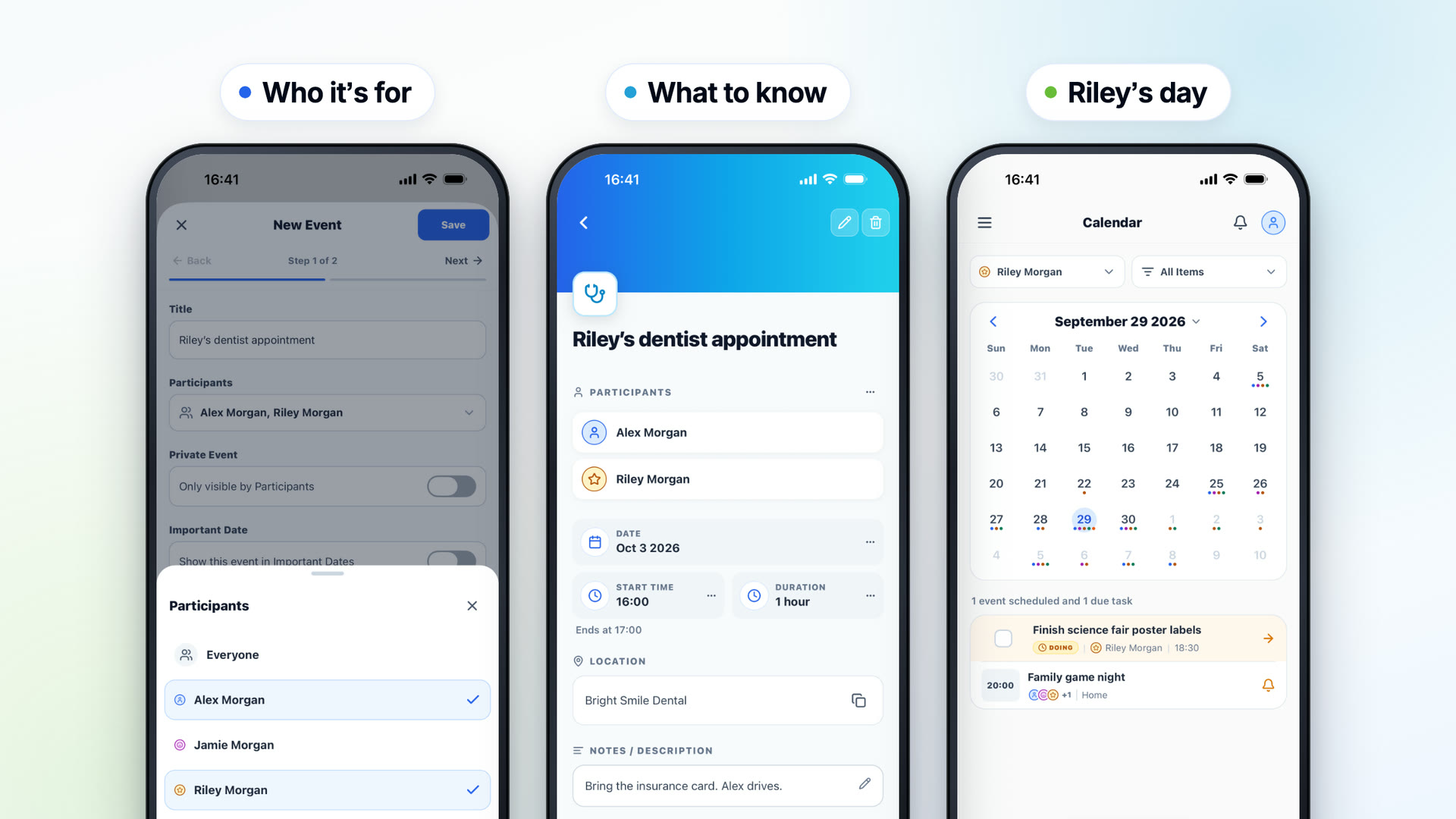
FamilyGoal's shared family calendar gives several of these rules a field on each event. Each event lists its participants, and each family member has their own color and icon. An event can also hold a location, notes and links, reminders and a repeat schedule. Tasks with an owner and a due time appear on the same day as the events, and you can filter the calendar to one person's plans.
Family members with access see the same event, so when you move the dentist appointment, they see the new time. Access can fit each person. An older child can see the family calendar and add their own plans without being able to edit events they don't join, and a younger child using Kids View in the native mobile app sees the tasks and routines assigned to them for today. The calendar works in the native mobile app and in a web browser, so the person who hears about a plan can add it wherever they are.
Start with the first rule today. Agree with your family that if a plan changes someone's pickup or dinner, it goes in the shared calendar.